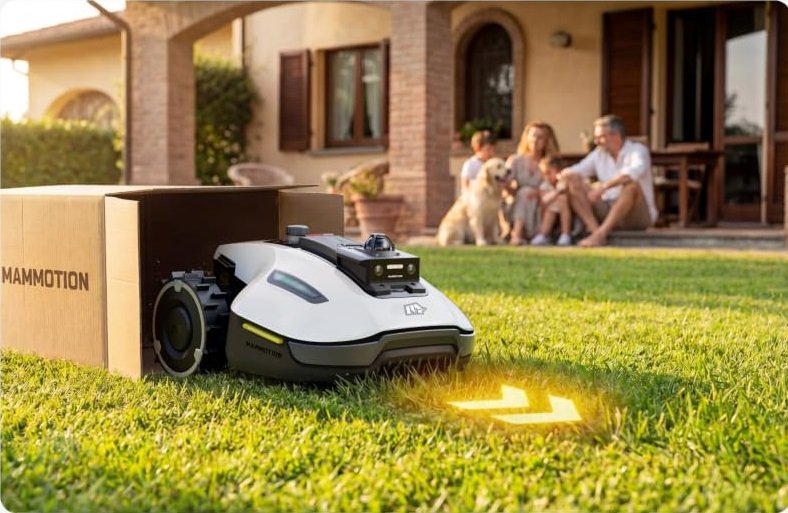
A good robot lawn mower can take care of the regular cutting without you having to push a mower around the garden every week. For Irish gardens, though, the choice depends on more than just cutting performance. Lawn size, slopes, navigation, boundary-wire installation and how well the mower handles changing weather all matter.
We’ve selected five robot lawn mowers worth considering for Irish homes, covering everything from compact gardens to larger lawns. The models below include both traditional boundary-wire systems and newer wire-free options, so you can compare the features that matter before buying.
1. eufy Robot Lawn Mower E15
Best Overall

The eufy E15 is a wire-free robot lawn mower designed for gardens up to 800 m². It uses high-precision cameras and vision-based navigation to automatically map the lawn, plan mowing routes and detect obstacles without requiring a boundary wire or RTK station. It also combines mowing with edge trimming and can be controlled through the eufy app.
- No boundary wire or RTK station required
- Hands-free automatic lawn mapping
- Accurate 3D obstacle avoidance
- Combines mowing and edge trimming
- Automatic parallel mowing for even coverage
- GPS tracking for added security
- Automatically returns to its charging station
2. MAMMOTION YUKA mini 2 1000
Best Value

The MAMMOTION YUKA mini 2 1000 is a boundary-free robot lawn mower designed for lawns up to 1,000 m². It combines 360° LiDAR with AI vision to map the garden, navigate around obstacles and plan efficient mowing routes. It can also handle slopes up to 45%, mow at heights from 20–60 mm and manage up to 10 separate mowing zones.
- No boundary wire required
- 360° LiDAR and AI vision navigation
- Recognises more than 300 types of obstacles
- Covers up to 1,000 m²
- Can mow up to 1,600 m² per day
- Handles slopes up to 45% (24°)
- Adjustable cutting height from 20–60 mm
- Intelligent edge cutting
- Supports up to 10 non-continuous mowing zones
- DropMow mode for quick mowing without mapping
- Virtual walls and no-go zones
3. DREAME A1 Pro Robot Lawn Mower
Best for Large Lawns

The DREAME A1 Pro is a cordless robot lawn mower designed for larger gardens of up to 2,000 m². It uses 3D-LiDAR OmniSense technology to map the lawn without boundary cables or an RTK terminal, while its intelligent obstacle avoidance helps it navigate around objects. The mower can be managed through the Dreamehome app, including mowing zones, schedules and areas that should be avoided.
- Covers lawns up to 2,000 m²
- No boundary cables or RTK terminal required
- 3D-LiDAR OmniSense navigation
- Omnidirectional obstacle avoidance
- Customisable mowing and forbidden areas
- Real-time and scheduled mowing through the app
- Powerful off-road wheels for better traction
- U-shaped mowing pattern for consistent coverage
- Can manage large lawns within 24 hours
What to Look for When Buying a Robot Lawn Mower
Choosing a robot lawn mower is mainly about matching the machine to your garden. A small, simple lawn does not need the same navigation system or battery capacity as a large garden with slopes, trees and separate grass areas.
Lawn Size
Check the manufacturer’s recommended lawn area before buying. It is better to choose a mower with some extra capacity rather than one that is rated exactly for the size of your lawn. A mower working close to its maximum capacity may need to run for longer periods to maintain the grass.
For example, current residential models can range from around 600 m² to several thousand square metres, depending on the model.
Boundary Wire or Wire-Free Navigation?
Traditional robot lawn mowers use a boundary wire installed around the edge of the lawn. The wire defines where the mower can operate and can also be used to create islands around flower beds and other areas you want it to avoid.
Wire-free models use technologies such as satellite positioning to create virtual boundaries. This can make installation and future changes easier because you don’t have to physically move or replace a buried wire.
For a straightforward garden, a wired model can still be perfectly practical. If your lawn changes regularly or has several mowing zones, wire-free navigation can be more convenient.
Slopes and Uneven Lawns
If your garden has a slope, pay close attention to the mower’s maximum gradient rather than assuming every robot mower can handle it.
The maximum slope varies considerably between models. For example, the Husqvarna Automower 405X is rated for slopes up to 40% inside its working area, while some larger models are designed to handle considerably steeper terrain.
Wet grass can also make steep slopes more difficult because the wheels can lose traction, so check the manufacturer’s slope rating for your particular model and garden layout.
Cutting Width and Height
A wider cutting width can help a mower cover a larger lawn more efficiently, while cutting-height adjustment lets you choose how short you want the grass.
For most domestic lawns, being able to adjust the cutting height is more useful than simply choosing the mower with the widest blade system. If you prefer slightly longer grass, make sure the model can accommodate the height you want.
Navigation and Obstacle Detection
Basic robot mowers can work well on uncomplicated lawns, but gardens with trees, flower beds, furniture and narrow passages benefit from better navigation.
Some newer models use cameras or other sensors to detect objects and avoid them. Wire-free models can also use satellite-based positioning to create virtual mowing boundaries and manage different areas.
Before running any robot mower, it is still sensible to remove toys, tools, cables and other objects from the lawn.
Battery Life and Charging
Robot lawn mowers normally return to their charging station automatically when the battery gets low and resume mowing afterwards. For a larger lawn, look at the mower’s recommended lawn capacity and operating time rather than concentrating only on battery size.
The important question is whether the mower can maintain your entire lawn through its normal mowing schedule without constantly struggling to keep up.
App Control
Many modern robot lawn mowers can be controlled through a smartphone app. Depending on the model, you may be able to create schedules, change mowing settings, monitor the mower and establish separate working areas.
This is particularly useful if you don’t want the mower running while people are using the garden.
Weather Resistance
Ireland’s frequent rain makes weather protection particularly important. Look for a mower designed to operate in wet conditions and check the manufacturer’s instructions about when it should be used.
Some current models are specifically designed to continue mowing in rainy conditions, although severe weather can affect certain satellite-based navigation systems.
A small mower garage or sheltered charging area can also help protect the machine from prolonged exposure to sun and rain.
How Do Robot Lawn Mowers Work?
A robot lawn mower cuts grass automatically according to a schedule you set. Depending on the model, it uses either a physical boundary wire or virtual boundaries to determine where it is allowed to mow.
Once configured, the mower leaves its charging station, cuts the grass using small rotating blades and moves around the defined area. When its battery needs charging, it returns to the station automatically. After charging, it can resume its mowing programme.
Rather than cutting large amounts of grass occasionally, robot mowers generally work little and often. This keeps the lawn at a relatively consistent height and reduces the amount of grass being cut at once.
Are Robot Lawn Mowers Worth It?
For people who dislike spending time mowing the lawn, a robot mower can be a worthwhile investment. The main advantage is convenience: once the mower has been installed and programmed correctly, most of the regular mowing can happen automatically.
They are particularly useful for gardens that need frequent mowing during the growing season. However, they are not completely maintenance-free. The blades need replacing periodically, the mower needs cleaning and the lawn still needs occasional attention around edges and areas the robot cannot reach.
The initial installation can also take some work, particularly with a boundary-wire model. Wire-free systems can make this easier, although they usually come with their own requirements for positioning and satellite connectivity.
How to Maintain a Robot Lawn Mower
Regular maintenance is relatively straightforward:
- Clean grass from the underside and wheels.
- Check and replace the cutting blades when necessary.
- Keep the charging station clear.
- Check the boundary wire if the mower starts behaving unusually.
- Keep the lawn free of objects that could obstruct the mower.
- Check the wheels regularly, particularly if the garden has slopes.
- Keep the mower and charging station protected according to the manufacturer’s instructions.
Grass can build up around the wheels and affect traction, particularly when mowing slopes, so regular cleaning is useful.